Understand your home
Your priorities, daily patterns and available equipment readings help shape the plan.

Learning centre
Comfort when you need it. Energy purchased and stored at a better time.
Endurous aims to balance household loads, time-varying grid prices, solar forecasts, battery reserves and useful heat. It considers when energy is needed as well as how much it costs.
Your priorities, daily patterns and available equipment readings help shape the plan.
Weather, energy rates and expected needs help determine when to use or store energy.
Coordinate compatible equipment, check how the home responds and improve the next plan.
A thermal store saves useful heat, or cooling with suitable equipment, for another time. Its size, losses and delivery system shape what it can provide.
Heating & cooling ↗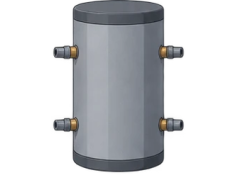
During an expensive evening, stored battery energy can support dinner and other loads while stored heat supports comfort and hot water. Vehicle and battery charging can wait until peak prices end, within the limits of the equipment and your plans.
On-site electricity and heat should be evaluated together. Solar surplus can charge a battery or support heating. Micro-CHP and fuel cells can provide electricity with recovered heat where a professionally designed project supports them.
The value depends on tariff differences, export credits, efficiency, storage losses and use patterns. The scenario tool separates changes from added equipment and changes from scheduling. It does not add incentive estimates to savings.
Flat, time-of-use and dynamic prices create different opportunities. Include export credit, any demand charges and applicable variable fees. Fixed standing charges remain even when grid purchases fall.
Solar, micro-CHP and fuel cells have different costs and operating limits. Recovered heat has value when the home can use or store it. If the thermal store is full and heat demand is low, running generation may be less useful. Fuel, maintenance, starts and storage losses belong in the comparison.
A morning plan can prepare hot water and departure needs, use midday solar and reserve stored electricity and heat for expensive evening hours. When peak pricing ends, suitable systems can recharge the battery and vehicle. A cloudy afternoon or early return should prompt a new plan within your preferences.
The public calculator separates new solar-and-battery equipment from better scheduling of the same equipment. It charges the battery with surplus solar; it does not simulate off-peak grid charging. Monthly and yearly figures repeat one example day for 30 or 365 days. They exclude equipment cost, degradation, fixed fees, taxes and incentives, and are not a seasonal home forecast.
Compare how stored electricity, useful heat and water reserves could sustain the household needs you choose.
Compare outage readiness ↗Start with what matters, keep useful equipment and explore improvements in stages.
Home planner ↗